From the founder
14 min read · Published June 26, 2026 · Last updated July 19, 2026
Why Goodwill Is the Secret to Better Airbnb Reviews
After more than a decade of hosting, I’ve become convinced that guests don’t review incidents. They review how they felt about the stay. Here’s why.
Before we begin, this article isn't about JottoGo. It's about the thinking that eventually led me to create JottoGo. My hope is that by the time you finish reading it, you'll have a new way of thinking about the relationship between hosts and guests, along with a few practical ideas you can start using in your own property right away.
Most articles about improving your Airbnb reviews focus on things like cleanliness, communication, amenities, and asking guests to leave a review. They're all important. But after more than a decade of hosting, I've come to believe they're missing one of the biggest pieces of the puzzle.
Have you ever received a disappointing review because of something that wasn't your fault? Many hosts have. A guest mentions the Wi-Fi outage, the neighbor's lawn mower, the car alarm outside, or the roadworks down the street. And you're left wondering why one small issue overshadowed an otherwise wonderful stay.
Over the years, I've become convinced that guests don't review incidents. They review how they felt about the stay overall. That's why two guests can experience exactly the same problem and leave completely different reviews.
The difference is goodwill.
Imagine you were an exhausted guest
Before designing your arrival experience, imagine arriving at your own property as a guest. You've spent hours on a plane. Navigated airports, traffic, and unfamiliar roads. Dragged suitcases across car parks and footpaths.
You're tired, hungry, perhaps traveling with children, trying to coordinate multiple family members, or simply desperate to put your bags down, relax, and hope nothing else goes wrong.
By the time many guests arrive, they don't need another challenge. They need a chance to exhale. That's why some of the highest-return hospitality improvements are also the simplest: clear directions, easy parking instructions, a straightforward check-in process, fast Wi-Fi access, and a guidebook that answers common questions before they need to be asked.
Every question a guest doesn't have to ask removes friction from their stay. Hosts often assume guests remember grand gestures. In reality, guests frequently remember the absence of frustration. A smooth arrival tells guests something powerful: “Relax. We've got this.”
Get to know your guests
Most hosts know the reservation. Few know the people. Whenever possible, I try to learn a little more about the guests arriving. Why are they traveling? Who is coming? What are everyone's names? Are they celebrating something? Are they bringing pets? Do they have any dietary requirements or preferences?
I do this not because I want more information, but because I'm looking for opportunities to make their stay more personal.
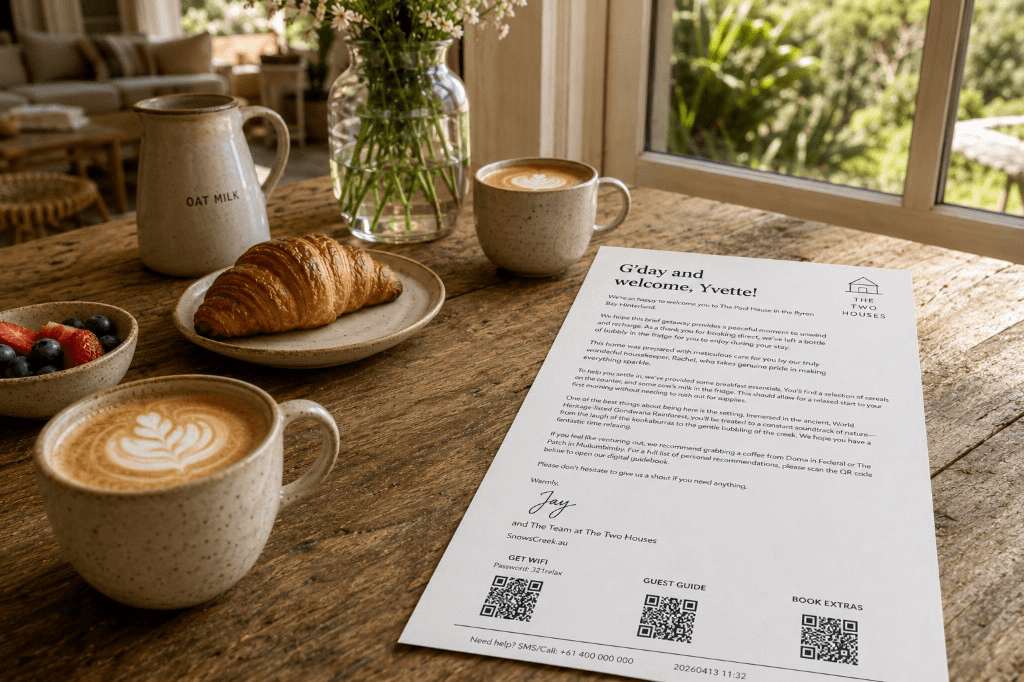
A guest mentioning an anniversary might create an opportunity for a small gift. A guest traveling with a dog might create an opportunity for a personalized welcome. A guest preferring oat milk might create an opportunity to stock the fridge with something they'll genuinely appreciate.
Not every guest wants to engage deeply, and that's perfectly fine. A short pre-arrival message with a handful of optional questions often tells us everything we need to know. If a guest chooses not to answer, that's perfectly okay too. Good hospitality isn't about knowing everything about your guests. It's about knowing enough to make them feel expected.
These questions do more than gather information. Asked before arrival, they often remove friction during the stay. More importantly, they signal attention. And attention is where goodwill begins.
Anticipate problems before guests encounter them
One of the simplest ways to create goodwill is to solve problems before guests realize they have one. Most hosts wait until a guest encounters a problem; great hosts anticipate it.
For example, one of my properties is located in the Byron Bay hinterland. If guests forget breakfast supplies, the nearest town is a significant drive away.
Over time, I noticed the same issue appearing again and again. Guests would arrive late, the shops would be closed, or they simply wouldn't have had time to stop along the way. So, I changed the system. Every guest now receives milk based on their preference, along with breakfast essentials such as oats and muesli.
The cost is small, but the impact is surprisingly large. Guests arrive, open the fridge, and realize somebody thought ahead. The same principle applies throughout the property with cooking oil, salt, pepper, and basic spices, the small essentials that are often forgotten when packing for a holiday. Guests rarely leave reviews praising a bottle of olive oil, but they absolutely notice when it's missing.
The goal is not to provide everything. The goal is to identify the most common frustrations and remove them before they occur. When guests discover that you've already solved problems they haven't even encountered yet, they learn something important: these hosts have thought about what our stay will actually be like. That is often one of the first deposits into the goodwill account.
Equip guests for the experience they came to have
Many hosts focus heavily on decoration. I focus heavily on functionality. Because while guests may admire a beautiful kitchen, they actually remember using it.
Have you ever tried preparing a family dinner on holiday with one blunt knife and an old scratched Teflon frying pan? Or discovered there isn't a mixing bowl, a decent chopping board, or even enough utensils for everyone staying in the property? It's frustrating, and frustration is a withdrawal from the goodwill account. Guests may not mention every missing item in their review, but they remember the feeling.
The opposite is also true. A well-equipped kitchen quietly creates goodwill. Sharp knives, quality cookware, proper utensils, and enough serving dishes. These are the little things that allow guests to cook comfortably and enjoy the experience they came to have. Guests rarely praise these things individually, but they absolutely notice when they're missing. Goodwill is often created by removing frustration before it occurs.
Recognition beats standardization
Hotels are built around standardization. Every guest receives the same experience: the same room, the same process, and the same welcome. There is nothing wrong with that; consistency is one of the hotel industry's greatest strengths. But independent hosts have an advantage that hotels often struggle to replicate: recognition.
Knowing who is arriving, remembering their names, recognizing a celebration, knowing a dog's name, or remembering a milk preference. These details are small in isolation. Together, however, they create something powerful: the feeling that somebody was paying attention. The feeling that somebody was expecting you.
A generic welcome note says: “Welcome, guest.” A personalized welcome note says: “Welcome Noni, Ben & Arnold.” The difference is subtle, but the emotional impact can be enormous. Guests rarely expect a host to remember these details. That's exactly why it matters when they do. Recognition creates trust, trust creates goodwill, and goodwill helps guests see your property and your efforts in the best possible light.
The “We Were Expecting You” moment
Guests love feeling expected. Not accommodated, not processed, but expected. When guests arrive at a property, they're carrying uncertainty. Have I got the right place? Will the property match the photos? Will everything work? Will this holiday be as good as I hoped?
The first few minutes matter enormously because they set the tone for everything that follows. My goal is to create what I call the “We Were Expecting You” moment. Imagine arriving after a long day of travel. You unlock the door and walk inside. Sitting on the dining table is a welcome note. It mentions your anniversary. Your dog's name appears in the note. Your preferred milk is already in the fridge.
Nothing here is particularly expensive. But in less than sixty seconds, you've learned something important: these hosts were expecting us. That feeling is surprisingly powerful. You are no longer just another booking in a calendar. You are a guest. For more on why that first minute matters so much, and the psychology behind it, read The Most Important Minute of Every Stay.
A generic welcome note rarely achieves this. In fact, it can sometimes have the opposite effect: when guests realize the same note is handed to everyone, the opportunity for connection disappears.
Why goodwill works
Goodwill does not make problems disappear. It changes how guests interpret them. Think back to the guest who arrived and immediately felt expected. Before they even unpacked their bags, they learned something important: these hosts pay attention. That creates trust, and trust changes everything that follows.
Over time, I've come to think of the process like this: Attention creates trust. Trust creates goodwill. Goodwill encourages forgiveness.
When a guest believes you care about them, small problems are viewed through a completely different lens. The Wi-Fi outage becomes an inconvenience rather than a betrayal. The delayed cleaner becomes an honest mistake rather than evidence of incompetence. A temporary hot water issue becomes something to solve together rather than something to complain about. The problem itself has not changed; the guest's interpretation has.
This is why goodwill is so valuable. Not because it creates perfect stays, but because perfect stays do not exist. Every host will eventually face a maintenance issue, a weather event, a delayed contractor, a broken appliance, or a simple human mistake. Goodwill is the emotional buffer that helps guests navigate those moments with grace.
Of course, goodwill is not a substitute for quality. It will not save a dirty property, misleading photos, or poor communication. Operational excellence remains essential. Goodwill is not a replacement for great hosting. It strengthens great hosting.
Acknowledge important moments
Guests often tell you why they are traveling: a birthday, an anniversary, a honeymoon, a babymoon, an engagement, or a long-awaited family reunion. Many hosts acknowledge these occasions. The best hosts participate in them.
That doesn't necessarily mean spending a lot of money. Sometimes it's a bottle of bubbly, a small gift, or simply a personalized note recognizing the occasion. The gesture itself is rarely the important part. What matters is that somebody noticed. Guests don't expect you to celebrate with them, which is exactly why it matters when you do.
When guests feel that you've taken an interest in an important moment in their lives, they often arrive with a stronger sense of connection to the property and the people hosting them. Once again, the principle is the same: attention creates trust, trust creates goodwill, and goodwill helps guests see your property and your efforts in the best possible light.
Help guests experience the destination
Guests don't usually travel for your property alone. They travel for what they hope to experience while they're there. A couple visiting for their anniversary is looking for connection. A family is looking for quality time together. A group of friends is looking for fun and shared memories.
Either way, your role extends beyond simply providing accommodation. Great hosts invest time in getting to know their region. Visit the local cafés, try the restaurants, and explore the walking trails.
Learn which attractions are genuinely worth recommending and which ones are overhyped. Build the guidebook you would genuinely want to receive yourself.
Don't create a long list of options. Curate. Help guests spend less time researching and more time enjoying their holiday. Every hour a guest spends searching for something to do is an hour they are not relaxing, exploring, or creating memories. Guests appreciate hosts who have already done the hard work for them. When one of your recommendations becomes a memorable meal, a beautiful walk, or the highlight of their trip, it creates another deposit into the goodwill account.
Recover brilliantly when things go wrong
Even the best hosts encounter problems. A burst pipe, a power outage, a delayed cleaner, or a broken appliance. Sooner or later, something won't go to plan. When that happens, remember that guests are judging more than the problem itself. They're judging how you respond.
A quick acknowledgement, honest communication, a genuine apology when appropriate, a clear plan, and regular updates if the issue takes time to resolve. These moments matter. Guests are surprisingly understanding when they feel informed, respected, and looked after. What frustrates them is silence, uncertainty, or feeling that nobody cares.
Goodwill won't fix a broken hot water system. But goodwill, combined with a thoughtful response, often changes how the experience is remembered. Problems are inevitable. How you recover from them is a choice. Recover well, and guests will often remember your response long after they've forgotten the problem itself.
Finish as strongly as you started
Many hosts invest heavily in arrival. Far fewer invest in departure. That's a mistake. The final hours of a stay have an outsized influence on the memory guests take home with them. A confusing checkout process, a surprise fee, or a last-minute dispute create withdrawals from the goodwill account at exactly the wrong moment.
One of the biggest offenders in modern short-term rentals is the checkout chore list. Guests pay a cleaning fee, then they're asked to strip beds, start the laundry, take out the rubbish, run the dishwasher, and complete a list of tasks before they leave.
Reasonable requests are one thing, but when guests feel like they are doing the cleaner's job after paying a cleaning fee, frustration builds quickly.
One experienced host recently shared an approach that perfectly illustrates the opposite philosophy. Instead of sending guests another list of checkout chores the night before departure, he simply reminds them where the checkout instructions can be found. He even tells guests that if they're short on time in the morning, there's no stress.
Counterintuitively, he found guests became more considerate, not less. They were more likely to let him know if they checked out early, making it much easier to organize cleaning, and they generally left the property in better condition.
As he put it: “People often do more when they feel trusted than when they feel managed.”
Trust is rarely created by asking less of guests. It's created by making guests feel that you trust them in the first place.
The opposite is also true. A simple checkout process, clear instructions, a thank-you message, and a wish for a safe journey home reinforce the relationship you've spent the entire stay building. Guests may forget many things about a trip, but they rarely forget how they felt when it ended. Finish strongly, and the goodwill you've worked so hard to create often stays with them long after they've gone home.
Scaling the goodwill approach
The challenge is that this way of hosting becomes harder as your portfolio grows. With one property, remembering a guest's anniversary is easy. With five properties, it becomes more difficult. With ten properties and dozens of arrivals every week, it can become almost impossible.
Most hosts eventually face a choice: standardize everything and lose the personal touch, or spend hours manually gathering guest information and preparing personalized arrivals. Neither option is ideal. This is where many hosts unintentionally become more like hotels. The messages become generic, the welcome notes become generic, and the guest experience becomes generic.
While there is nothing wrong with efficiency, something important gets lost: the feeling that somebody was expecting you.
JottoGo grew out of my own desire to solve this problem. I wanted a way to scale personalization without losing that feeling, not just for one property, but for five, ten, or fifty. Guests rarely remember every amenity, appliance, or feature. They almost always remember how you made them feel. And the hosts who make guests feel expected are often the hosts guests remember most.
Conclusion
If you've made it this far, you're already doing something many hosts never do. You're thinking deeply about the guest experience. You're looking for ways to improve, and you're investing time in becoming a better host.
Goodwill isn't a soft hospitality concept. It's a buffer of forgiveness that protects your pricing power.
Over the long term, those small improvements compound. Better guest experiences lead to better reviews. Better reviews create demand. And stronger demand gives hosts the ability to command higher nightly rates. For more on how goodwill shapes what guests are willing to pay, not just what they write in reviews, read Why Airbnb Guests Happily Pay Premium Prices.
The question is not whether reviews matter. They absolutely do. The question is how to consistently earn them.